


Validity and reproducibility of a food frequency questionnaire assessing food group intake in the PERSIAN Cohort Study
DOI: 10.3389/fnut.2023.1059870
Abstract
Purpose: A semi-quantitative food frequency questionnaire (FFQ) was developed for use in the Prospective Epidemiological Research Studies in IrAN (PERSIAN Cohort), investigating non-communicable disease risk factors. This study aimed to assess the validity and reproducibility of this FFQ, through food group intake.
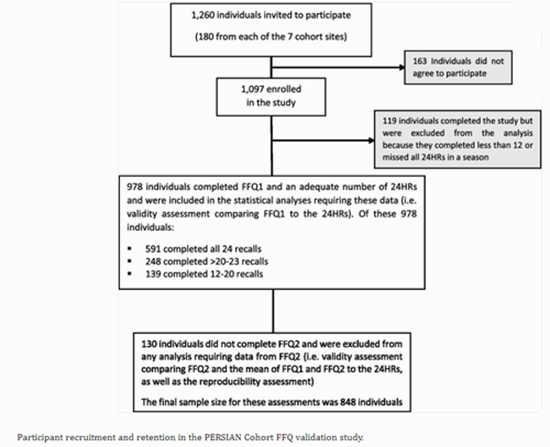
Methods: Participants, recruited from seven PERSIAN cohort centers, completed the FFQ at the beginning of the study (FFQ1) and at the end (FFQ2), with a 12-month interval in between, during which two 24-h dietary recalls (24 h) were completed each month. Correlation coefficients of the median intake of food groups recorded by the FFQs were compared to those of the 24 h to assess validity, and the two FFQs were compared to assess reproducibility of findings.
Results: Overall, data from 978 participants were included in this validation analysis. Of the 26 food groups assessed, Tea, Sugars, Whole/Refined Grains, and Solid Fats/Oils, had the strongest correlations (0.6-0.79), while Red Meat, Chicken and Eggs showed moderate correlations (0.42-0.59). The weakest correlations observed belonged to Fresh fruit Juice and Other Meats (0.23-0.32). Reproducibility was assessed among those who completed both FFQ1 and FFQ2 (n = 848), revealing moderate to strong correlations in all food groups, ranging from 0.42 in Legumes to 0.72 in both Sugar and Sweetened Drinks.
Conclusion: The PERSIAN Cohort FFQ is appropriate to rank individuals based on food group intake.
Keywords: FFQ; PERSIAN cohort; food frequency questionnaire; reproducibility; validity.
Citation: 64


ارسال نظر